In the world of scent detection, we are fortunate to work with one of nature's most incredible tools, our dog's nose, which can detect odours at levels beyond what we can imagine. Every dog is born with this amazing ability. What they truly need is a caring handler and a knowledgeable instructor who can nurture and guide that talent, transforming it into consistent, professional performance.
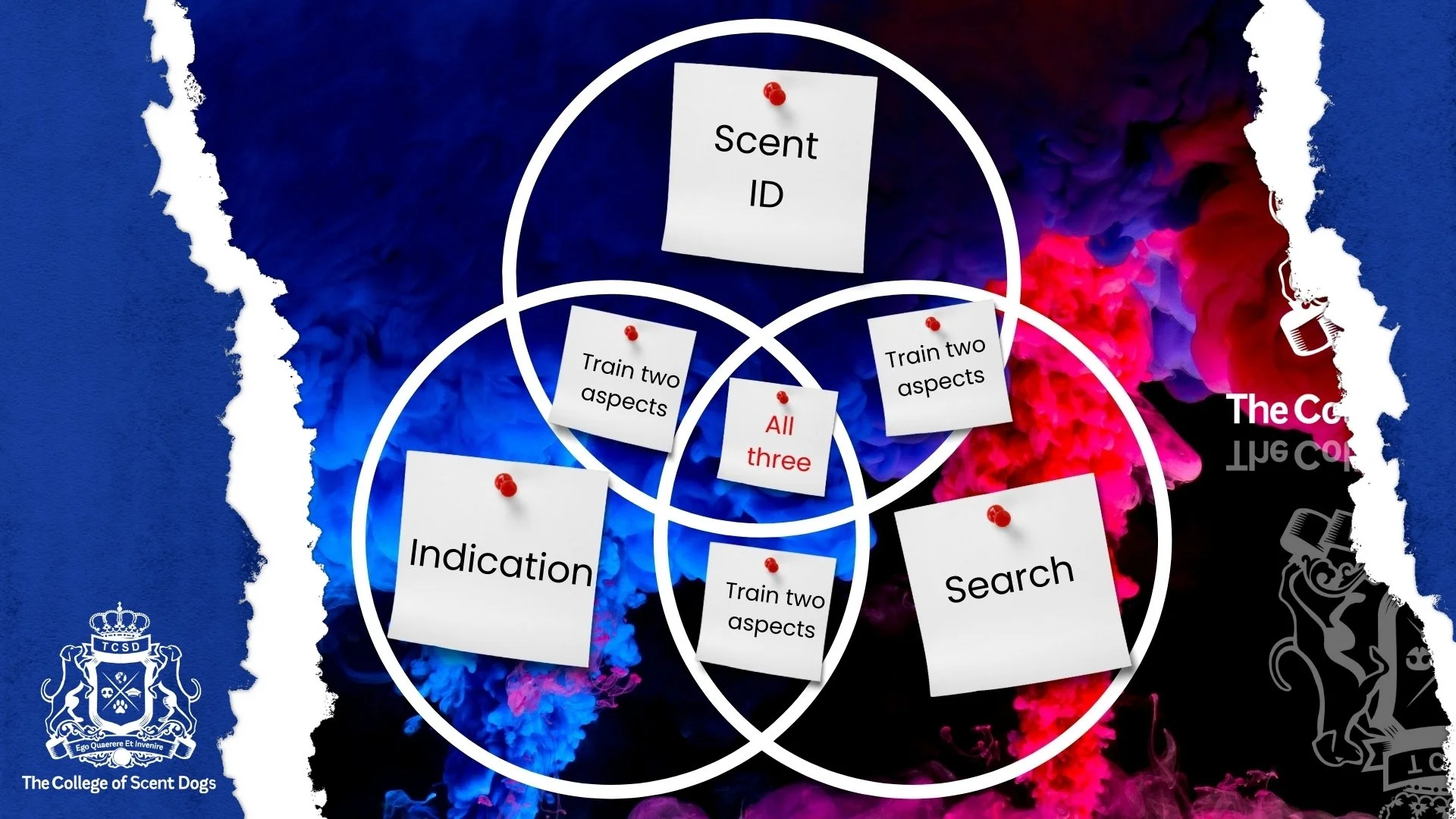
Imagine a framework that shows how the act of searching, scent identification, and the dog's indication work together to create true detection. Imagine knowing, in real time, where a session can be adjusted and which elements need reinforcement.
The Venn Diagram of Search does exactly this: it turns complex, overlapping behaviours into a clear, actionable model, allowing trainers to design sessions with intention, precision, and confidence.
In the world of detection dog work, we operate in a realm where invisible molecules become actionable cues, where a dog's nose can mean the difference between success and failure, truth and deception. But here's the uncomfortable reality we must confront: We are only as good as our weakest link, and guess what team! Too often, that link could be us, our training or even carelessness.
Detection work does not take place in controlled training environments with fresh, powerful odours and perfect airflow. It happens where odour is moving, disrupted, strong, or weak. Without deliberate exposure to variable odour strength, we teach dogs that certainty always exists, that odour is always obvious, and that the indication is always rewarded. In reality, uncertainty is the norm; if we fail to train for it, the dog may give false indications.
Poor scent husbandry can cause issues even before the dog starts its search. When hides are handled carelessly or residual odours are left in the environment, those careless moments become the "hides" that the dog is trained to find. This can cause the dog to be called away from its task, which might lead to confusion, frustration, and misunderstandings. In scent detection, managing odour carefully isn't just good practice; it's absolutely vital to support the dog's learning and confidence.
In scent detection, clarity is frequently confused with confidence. A dynamic sit, a sudden freeze, or a textbook indication reassures handlers and trainers alike. However, what if that clarity is not solely attributable to odour? What if the dog is responding not to scent, but to pressure? Today, we shall examine how excessive pressure during indication training systematically increases the likelihood of false indications, and why some of the most convincing alerts may, in fact, be the least dependable.