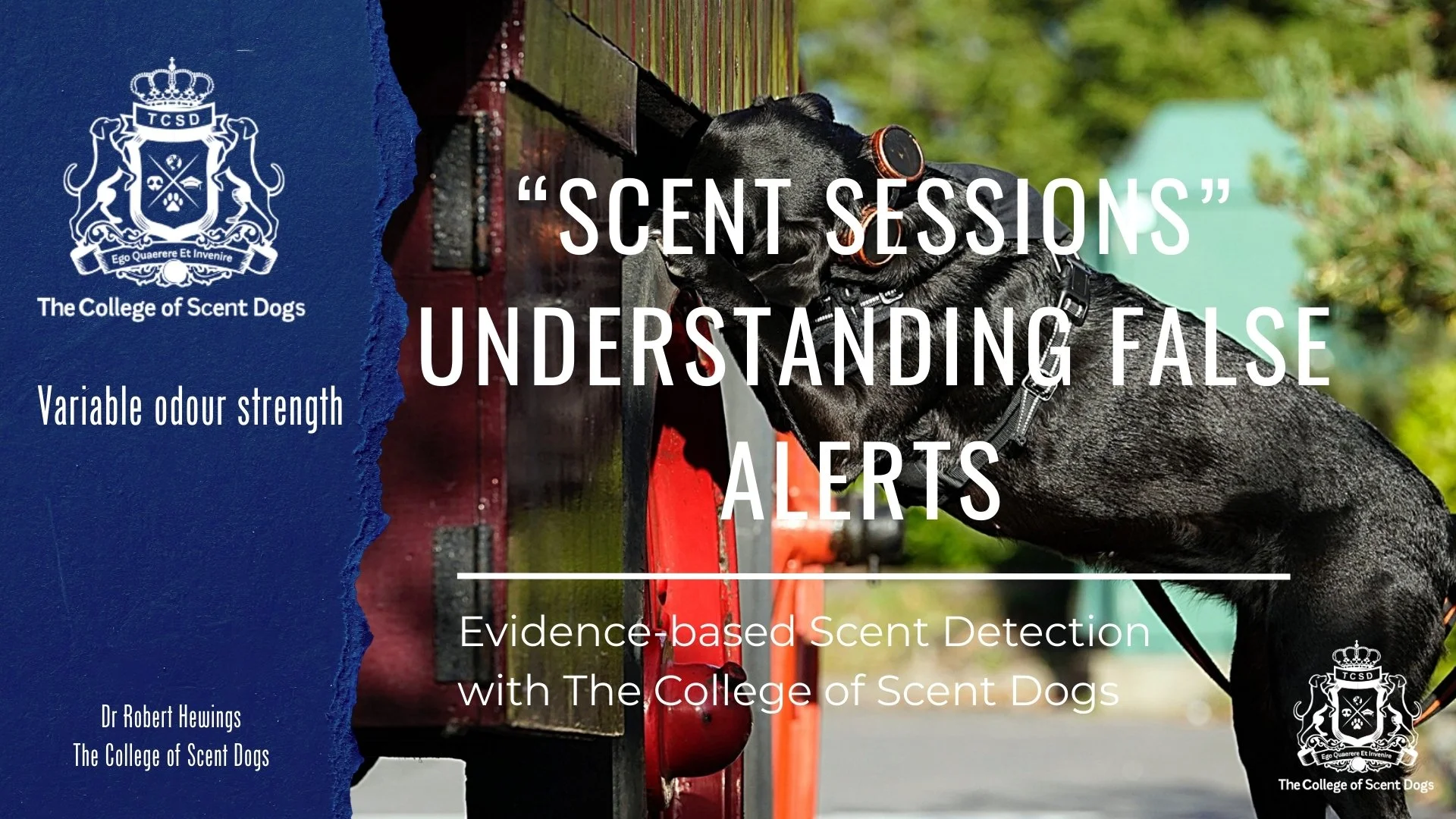
 Image 1 of 2
 Image 2 of 2
In this 20-minute Scent Session, Dr Robert Hewings examines how inconsistent odour strength influences search behaviour and directly contributes to false alerts.
When dogs are trained primarily with strong, clean odour presentations, they learn that detection is easy and information is abundant. As odour strength decreases or becomes more complex, the dog may continue to indicate out of expectation rather than confirmation. These indications often appear confident, but they are based on assumption, not odour certainty.
This session explains why deliberate exposure to weak, variable, and ambiguous odour conditions is essential for reliable detection. You will learn how variable odour strength teaches dogs to slow down, problem-solve, and wait for confirmation rather than guessing. False alerts in these conditions are not disobedience or a lack of drive; they are signs that uncertainty has not been adequately trained.
Part of the Understanding False Alerts series, this session can be watched on its own or alongside the complete set, each building towards clearer training, stronger foundations, and detection dogs that remain accurate when certainty disappears.
Reliability is not built in perfect conditions; it is built in uncertainty.
Scent Sessions are drawn from the teaching on The Scent Detection Programme, our City & Guilds Assured instructor credential. If this way of thinking is how you want to work, the full programme is where it lives — three weeks across the year, eighteen places, one cohort. See the City & Guilds Programmes.